You’ve noticed a change in your body. It doesn’t react like it used to. You eat the same and move as much, but you’re not losing weight and you’re tired.
Here’s the truth: yes, a high protein diet for women over 40 does increase your body’s calorie burning. But it’s not as quick or magical as some say. The science is real, but the effect is small and steady, not sudden.
This article cuts through the marketing noise. We’ll give you the honest truth about how dietary changes work in your body after forty. You’ll learn about the thermic effect of food and how much you really need.
Spoiler: it’s probably more than you’re eating, but less than Instagram tells you.
We’ll talk about the real ways protein works—like keeping muscle, using energy to digest, and controlling hunger. And we’ll give you practical tips based on research, not hype. You deserve to know what’s happening in your body and what you can do about it.
Key Takeaways
- Women after forty lose up to 8% of muscle mass each decade, which directly slows calorie burning since muscle tissue burns three times more energy than fat at rest
- Dietary changes that increase intake create a 15-30% temporary rise in metabolic rate through the thermic effect of food (your body burns calories just digesting it)
- Digesting and processing this nutrient requires 20-30% of its own calories, compared to just 5-10% for carbs and 0-3% for fats
- Research supports 1.2-1.6 grams per kilogram of body weight daily to preserve lean mass during weight loss and maintain metabolic rate
- The effect is real but modest—expect gradual, sustainable results rather than dramatic overnight changes
- Combining adequate intake with resistance training provides the most effective strategy for maintaining muscle tissue and energy expenditure
Editor’s Pick
Looking for a natural supplement designed specifically for women over 40?
★★★★★
Rated 4.8/5 by over 2,300 women — see why it’s our top pick this year.
Read Our CitrusBurn Review →Why Your Metabolism Changes After 40 (And Why It Matters)
Changes in your metabolism after 40 are real and backed by science. Your body burns fewer calories each day. Knowing this can help you take action instead of feeling stuck.
Here’s what’s happening in your body. After 40, you start losing muscle mass. This is called sarcopenia. It’s not because you’ve failed or done anything wrong.
It’s just how your body changes with age. Your muscle mass peaks at 30 and then starts to decline. This happens at a rate of 3-8% each decade.
By age 60, this loss speeds up even more. This is important because muscle tissue burns calories, even when you’re resting. Your muscles work hard, even when you’re just sitting.
Fat tissue doesn’t burn calories as much. As you lose muscle, your metabolism slows down. This might not seem like a lot, but it adds up over time.
| Age Range | Average Muscle Loss Rate | Impact on Daily Calorie Burn | Cumulative Effect |
|---|---|---|---|
| 30-40 years | 3-5% per decade | Minimal decrease | Baseline established |
| 40-60 years | 5-8% per decade | 50-100 fewer calories/day | Noticeable metabolic shift |
| 60+ years | Accelerated loss (8%+) | 100-150 fewer calories/day | Significant metabolic reduction |
| During weight loss (insufficient protein) | 25-35% of weight lost is muscle | Further metabolic slowdown | Compounds existing decline |
Trying to lose weight can be tough. When you cut calories, you might lose up to 25-35% of that weight as lean muscle mass. This is not just fat.
This makes your metabolism slower while you’re trying to lose weight. You’re losing the muscle that helps you burn calories. This creates a cycle where losing weight gets harder over time.
Protein becomes key after 40. It helps protect your muscles when you’re losing weight. This way, your body burns fat instead of muscle, keeping your metabolism strong.
Women over 40 often don’t get enough protein. This is why they lose muscle mass. The usual protein intake isn’t enough anymore.
This isn’t about reversing aging. It’s about keeping your body working well during big changes. You’re not getting older; you’re just changing.
Your body isn’t broken. It’s adapting. With enough protein, you can keep your muscles strong. This makes losing weight easier.
The link between protein and metabolism after 40 isn’t about magic. It’s about giving your body what it needs. When you eat enough protein, you protect your body’s ability to burn calories.
This makes reaching other health goals easier. The science is clear, and the plan is simple once you understand your body’s needs.
Does Protein Boost Metabolism for Women Over 40? The Scientific Answer
Let’s clear up the confusion: yes, protein does boost your metabolism. But let’s talk about what that really means for your body. The science is clear, but the practical impact might surprise you.
When you eat protein, your body works harder to break it down than other foods.
This extra work requires energy. This energy use is called the thermic effect of food (TEF). Think of TEF as the calories your digestive system burns just to process what you ate.
Protein has the highest thermic effect of all macronutrients. It burns 20-30% of its own calories during digestion and processing.
Here’s what that means in real numbers: if you eat 100 calories of protein, your body uses 20-30 of those calories just breaking it down. You’re left with a net 70-80 calories actually available for your body to use.

Compare that to carbohydrates and fats, and the difference becomes clear:
| Macronutrient | Thermic Effect | Calories Used in Digestion | Net Calories Absorbed |
|---|---|---|---|
| Protein | 20-30% | 20-30 per 100 eaten | 70-80 calories |
| Carbohydrates | 5-10% | 5-10 per 100 eaten | 90-95 calories |
| Fats | 0-3% | 0-3 per 100 eaten | 97-100 calories |
Fat requires almost no energy to digest, so you get nearly 100% of its calories. Carbohydrates fall somewhere in the middle.
But protein? Your body burns significant energy just processing it. That’s why choosing the right protein sources matters for women over.
After you eat a high-protein meal, your metabolic rate increases by 15-30% for several hours. This is real and measurable. Your body is literally burning more calories for hours after eating protein-rich foods.
Now here’s where we need to be radically honest with you. In practical daily terms, this metabolic boost usually translates to an extra 50-100 calories burned per day.
That’s not the dramatic calorie-torching effect some diets promise. It won’t create instant weight loss on its own.
But—and this is important—those 50-100 calories daily add up over time. Over a year, that equals roughly 5-10 pounds of fat loss, assuming everything else stays consistent.
This difference is meaningful but gradual. Protein works as part of an overall approach, not as a magic solution.
The metabolism-boosting effect of protein is one piece of why it matters so much after 40. It’s not the only reason, and it’s not going to revolutionize your body overnight.
But combined with protein’s other benefits—which we’ll explore next—this thermic effect contributes to a comprehensive strategy for maintaining your metabolic health as you age.
The Thermic Effect of Food: How Protein Burns Calories Just Being Digested
Most women don’t know this: digesting protein burns more calories than carbs or fat. This is called the thermic effect of food, or TEF. It’s why protein helps increase metabolism.
Your body uses energy to digest, process, and store food. But not all nutrients require the same effort.
Digesting protein is like climbing stairs for your body. It’s harder than taking an elevator. Both get you there, but one burns more energy.
The science behind this is interesting. When you eat protein, your body does several energy-intensive jobs:
- Deamination: Your body removes amino groups from amino acids, which requires significant energy
- Gluconeogenesis: Sometimes your body converts amino acids into glucose when you need it, another costly process
- Protein synthesis: Building new proteins for your muscles, organs, and immune system demands substantial ATP (your body’s energy currency)
All these processes burn calories. That’s why protein has a metabolic advantage.
Protein vs. Carbs vs. Fat: The Calorie-Burning Comparison
Let’s look at the actual numbers. The differences between macronutrients are striking:
| Macronutrient | Thermic Effect (TEF) | Calories Burned Per 100 Calories Eaten | Net Calories Absorbed |
|---|---|---|---|
| Protein | 20-30% | 20-30 calories | 70-80 calories |
| Carbohydrates | 5-10% | 5-10 calories | 90-95 calories |
| Fats | 0-3% | 0-3 calories | 97-100 calories |
This isn’t just a diet trick. It’s basic biochemistry backed by research.
Protein requires five to ten times more energy to process than fat. This is a big difference, especially if you eat protein at every meal.
“The thermic effect of protein is significantly higher than that of carbohydrates and fat, making it a valuable component in weight management strategies, particularly for individuals over 40 experiencing metabolic decline.”
Carbohydrates are in the middle. Your body burns about 5-10% of the calories from carbs just processing them. That’s better than fat but nowhere near protein’s metabolic advantage.
Fat barely requires any digestive energy at all. Only 0-3% of fat calories get burned during processing. Your body stores fat efficiently because it doesn’t need much energy to do so.
What 20-30% TEF Actually Means for Your Daily Calorie Burn
Let’s do the math together so you can see real numbers. This makes the concept concrete instead of abstract.
If you eat 100 grams of protein per day, that’s 400 calories from protein. Your body will burn roughly 80-120 of those calories just processing it. That’s a significant chunk returned just for digestion.
Now compare that to eating 100 grams of fat (which contains 900 calories). Your body only burns about 0-27 calories processing that fat. The difference is dramatic.
Here’s another way to think about it:
- Woman eating 120g protein daily: Burns approximately 96-144 extra calories through TEF alone
- Woman eating 60g protein daily: Burns approximately 48-72 extra calories through TEF
- Difference: 48-72 additional calories burned daily just by increasing protein intake
Over a month, that difference adds up to roughly 1,440 to 2,160 calories. That’s meaningful, especially when combined with protein’s other metabolic benefits.
But here’s the radically honest truth: this thermic effect is just one piece of the metabolism puzzle. It matters, it adds up, but it’s not going to compensate for eating way more calories than you burn overall.
Think of TEF as a helpful metabolic advantage that works best when combined with appropriate portion sizes and regular movement. It’s not a loophole that lets you eat unlimited amounts.
The real power comes from combining this thermic effect with protein’s other benefits. When you choose protein rich foods to increase metabolism, you’re not just getting the immediate calorie burn from digestion.
You’re also preserving your muscle mass, staying fuller longer, and supporting dozens of metabolic processes in your body. That’s where the magic really happens for women over 40.
The thermic effect is your metabolic ally, working quietly in the background every time you eat. It’s not flashy, but it’s reliable, measurable, and backed by solid science.
Editor’s Pick
Looking for a natural supplement designed specifically for women over 40?
★★★★★
Rated 4.8/5 by over 2,300 women — see why it’s our top pick this year.
Read Our CitrusBurn Review →How Protein Preserves Lean Muscle Mass and Protects Your Metabolic Rate
Women over 40 often make a big mistake when dieting. They don’t eat enough protein. When you cut calories, your body needs to know what to keep and what to lose. Without enough lean protein for weight management over 40, your body starts breaking down important tissue.
This isn’t just about looking good. It’s about keeping your metabolism strong. This helps you maintain your weight loss over time and stay active for years.
The Muscle-Metabolism Connection After 40
Your muscle tissue is metabolically active. It burns calories all the time, even when you’re not moving. Each pound of muscle burns about 6 calories daily, compared to 2 calories for fat.
While 6 calories might seem small, it adds up quickly. More muscle means you can move better, lift things, and stay independent as you age.

After 40, you start losing muscle naturally. Women can lose 3-8% of their muscle mass per decade, starting in their 30s. This loss speeds up after menopause. Without enough protein and strength training, you lose muscle fast.
Think of muscle as your metabolic insurance. The more muscle you have, the more calories you burn naturally. This makes it easier to keep a healthy weight without extreme dieting.
Why Losing Weight Without Adequate Protein Damages Your Metabolism
Restricting calories without enough protein is a big mistake. Your body doesn’t just burn fat; it also breaks down muscle for energy. Studies show that 25-35% of weight lost during calorie restriction comes from muscle, unless you protect it.
This is metabolic self-sabotage. You see the scale go down, but you’ve lost the tissue that helps you burn calories well.
Your metabolic rate slows down, making it harder to lose weight and easier to gain it back. You end up eating less just to stay at your new weight, feeling frustrated and deprived.
The solution is simple. Studies show that eating 1.2-1.6 grams of protein per kilogram of body weight daily helps keep more muscle during weight loss. That’s about 0.55-0.73 grams per pound of body weight.
For a 150-pound woman, that’s 82-109 grams of protein daily. For a 180-pound woman, it’s 99-131 grams. Adding resistance training just twice a week protects your metabolism while you lose fat instead of muscle.
| Scenario | Protein Intake | Muscle Mass Preserved | Metabolic Impact |
|---|---|---|---|
| Low protein diet | 0.4-0.5g per pound | 65-75% retained | Significant metabolic slowdown |
| Moderate protein diet | 0.55-0.73g per pound | 85-95% retained | Minimal metabolic adaptation |
| High protein + resistance training | 0.7-1g per pound | 95-100% retained | Metabolic rate protected or improved |
This isn’t optional for lasting results. It’s essential. Every gram of lean protein for weight management over 40 tells your body to keep muscle and burn fat instead.
The choice between a diet that harms your metabolism and one that protects it is simple. Get your protein right, add strength training, and you’ll lose weight while keeping your metabolism strong. Skip protein, and you’ll face a tough battle against your body.
Your metabolism after 40 doesn’t have to decline. But you need to give your body the amino acids from protein to keep muscle tissue. This is the key to lasting weight loss.
How Much Protein Do Women Over 40 Actually Need?
Wondering how much protein you should eat each day? You’re not alone. The old rule of 0.36 grams per pound was made decades ago. It was meant to prevent deficiency, not to help you stay healthy or protect your muscles.
For women over 40, you need more protein. It helps keep your muscles strong, supports your metabolism, and makes you feel good during this life stage.
Let’s clear up the confusion and give you real numbers to use today.
Understanding the Research-Backed Formula
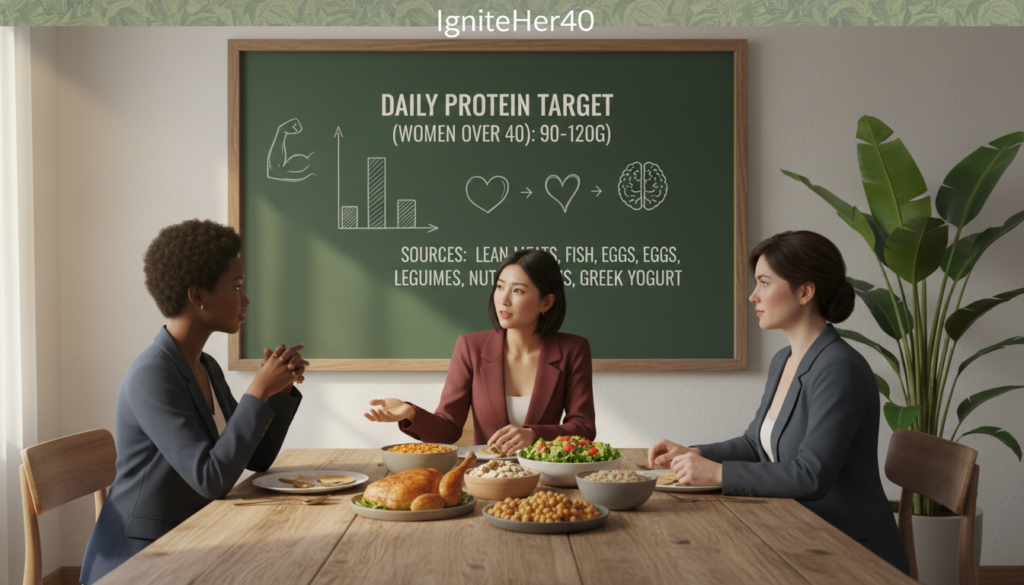
The best protein intake for midlife women is between 0.7 and 1 gram per pound of body weight daily. This means about 1.6-2.2 grams per kilogram. This amount is perfect for your body’s needs.
Why this range? It’s backed by studies on protein needs for adults, especially for keeping muscles during weight loss and aging.
Here’s what science says for different situations:
- General maintenance: 1.2-1.6 g/kg body weight (0.55-0.73 g/lb)
- Active lifestyle: 1.4-2.0 g/kg body weight (0.64-0.91 g/lb)
- During calorie restriction: 1.6-2.0 g/kg body weight (0.73-0.91 g/lb)
Just multiply your body weight in pounds by 0.7 to 1.0. That’s your daily protein goal in grams.
A 150-pound woman needs 105-150 grams daily. A 140-pound woman needs 98-140 grams. A 160-pound woman needs 112-160 grams.
Your Daily Target Range and Why It Works
Most women over 40 weigh between 120 and 160 pounds. This means they need about 100-130 grams of protein per day. This is the ideal amount for real benefits.
If you’re eating 50-60 grams daily, this might seem a lot. But with some planning, it’s achievable.
Let’s explain why this range is important:
| Body Weight | Minimum Target (0.7g/lb) | Optimal Target (0.85g/lb) | Upper Range (1.0g/lb) |
|---|---|---|---|
| 130 pounds | 91 grams | 110 grams | 130 grams |
| 150 pounds | 105 grams | 128 grams | 150 grams |
| 170 pounds | 119 grams | 145 grams | 170 grams |
These targets help keep your muscle mass during weight loss. They also keep your metabolism up and make you feel full longer. This makes it easier to eat healthy.
Research shows older adults might need 25-40 grams per meal because of age-related muscle resistance. Your body gets less efficient at using protein as you age. So, eating enough protein at each meal is key.
This isn’t about being perfect. What matters most is being consistent in your target range. It’s better than trying to hit an exact number every day.
Personalizing Your Protein Goals
Your optimal protein intake isn’t the same for everyone. It depends on your activity level, goals, and what your body responds to best.
Start with the lower end if you’re sedentary. If you’re just starting to focus on protein and aren’t exercising much, aim for 0.7 grams per pound. This lets your body adjust without overwhelming your digestive system.
Move toward the middle range if you’re moderately active. Walking daily, doing light strength training, or staying active? Target 0.8-0.85 grams per pound.
Aim for the higher end in these situations:
- You’re strength training 2-3 times per week or more
- You’re actively trying to lose fat while preserving muscle
- You’re in a significant calorie deficit (eating 300+ calories below maintenance)
- You’re recovering from illness or injury
During calorie restriction, research supports 1.6-2.0 g/kg body weight (approximately 0.73-0.91 g/lb) to preserve muscle mass. This is when your body most needs the protective benefits of adequate protein.
Special considerations matter too. If you’re pregnant or breastfeeding, you need about 1.25 times the baseline recommendation. Always talk to your healthcare provider about big dietary changes during these times.
These aren’t strict rules you must follow perfectly. They’re guidelines you can adjust based on how you feel, your results, and your lifestyle. Some women thrive at 0.8 grams per pound. Others feel and perform better closer to 1 gram per pound.
Pay attention to your energy levels, hunger cues, and how your clothes fit. These real-world indicators matter more than hitting a precise number on a calculator.
The key is finding your personal sweet spot—the amount that supports your goals without feeling impossible to maintain. Start somewhere in your range, stay consistent for 2-3 weeks, and adjust based on your results.
Best High-Protein Foods for Metabolic Support: A Complete Comparison
Finding the best protein sources for your metabolism isn’t hard. You can find them at your local grocery store. You don’t need to spend a lot or follow a complicated diet to boost your metabolism after 40.
What you do need is to know which foods have the most protein. You also need to understand how these foods fit into your daily meals without adding extra calories or hassle.
Let’s look at the top choices. This way, you can create meals that work well for your body and lifestyle.
Top Animal-Based Protein Sources
Animal-based proteins have all nine essential amino acids your body needs. They are efficient, meaning you get a lot of protein without eating too much.
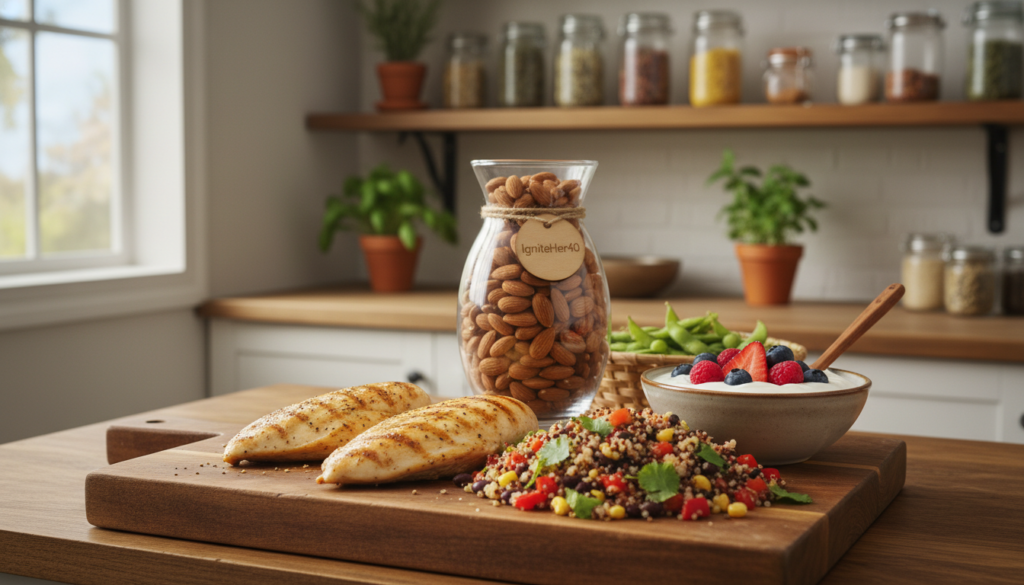
Chicken breast is a top choice with about 30 grams of protein per 4-ounce serving. It’s lean, versatile, and fits into almost any meal style.
Eggs are nutrition powerhouses at 6 grams each. Two eggs give you 12 grams of protein plus important nutrients like choline and vitamin D. They’re perfect for breakfast or as a quick protein boost any time of day.
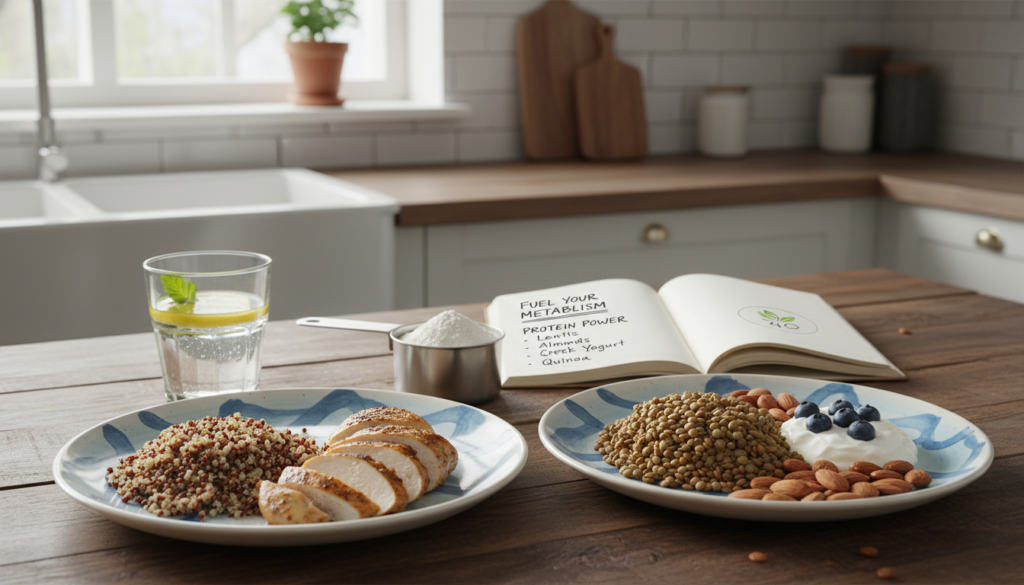
Greek yogurt provides 15-20 grams per cup, depending on the brand. Look for versions without added sugar to avoid unnecessary carbs. The thick, creamy texture makes it satisfying as a snack or breakfast base.
Cottage cheese offers 12-15 grams per half cup. Many women skip this one because of texture preferences, but it’s an incredibly efficient protein source that pairs well with both sweet and savory foods.
Salmon delivers 25 grams per 4-ounce serving plus omega-3 fatty acids your heart and brain need. Fatty fish like salmon support metabolic health beyond just protein content.
A palm-sized portion of chicken or fish—about 3 to 4 ounces—gives you 20 to 25 grams. That’s roughly one-fifth to one-quarter of your daily protein target in a single serving.
Plant-Based Protein Options
Plant proteins come with bonus nutrients that animal sources don’t provide. You get fiber, antioxidants, vitamins, and minerals that support overall health while meeting your protein needs.
Lentils pack 18 grams per cooked cup along with substantial fiber. They’re budget-friendly, shelf-stable, and incredibly versatile in soups, salads, and side dishes.
Chickpeas provide 15 grams per cooked cup. Whether you roast them for snacks, blend them into hummus, or toss them in salads, they’re a staple worth keeping on hand.
Tofu offers 10 grams per half cup and absorbs whatever flavors you cook it with. It’s a blank canvas that works in everything from stir-fries to smoothies.
Edamame delivers an impressive 17 grams per cup. These young soybeans make an easy snack or salad topper with minimal preparation required.
Tempeh provides 15 grams per half cup with a firmer texture than tofu. The fermentation process may make it easier to digest and adds beneficial probiotics.
Research from the Nurses’ Health Study shows something important. Women who got their protein primarily from beans, nuts, and dairy products had significantly lower risk of chronic diseases compared to those relying heavily on red meat.
You don’t have to choose between animal and plant sources. Most women thrive with a combination based on personal preference, values, and how their body responds to different foods.
Protein Shakes and Supplements: When They Make Sense
Let’s be honest about protein powders. Whole foods are always your best choice, but supplements serve as practical tools when you’re short on time or struggling to hit your targets.
A quality protein powder gives you 20-30 grams per scoop. That’s equivalent to a chicken breast, but you can mix it into a smoothie in under two minutes.
Look for third-party tested brands to ensure purity and safety. Some protein powders contain heavy metals or contaminants, especially concerning if you’re pregnant or breastfeeding. Brands with NSF or Informed-Choice certification have been independently verified.
Protein shakes make sense in specific situations. They’re useful immediately post-workout when your muscles need quick amino acids. They work as breakfast additions when you’re rushing out the door. They help bridge the gap between meals when you need a quick 20-gram boost.
What they shouldn’t become is your primary protein source. Your body benefits from the complete nutritional package in whole foods—the vitamins, minerals, fiber, and other compounds that powders can’t fully replicate.
Use supplements strategically, not as replacements for real food.
| Food Source | Serving Size | Protein Content | Key Benefits |
|---|---|---|---|
| Chicken Breast | 4 ounces | 30 grams | Lean, versatile, complete amino acids |
| Greek Yogurt | 1 cup | 15-20 grams | Probiotics, calcium, convenient |
| Salmon | 4 ounces | 25 grams | Omega-3 fats, vitamin D, heart health |
| Lentils | 1 cup cooked | 18 grams | High fiber, budget-friendly, shelf-stable |
| Protein Powder | 1 scoop | 20-30 grams | Fast preparation, portable, consistent dosing |
The best high-protein foods for metabolic support are the ones you’ll actually eat consistently. Choose options that fit your taste preferences, cooking skills, budget, and lifestyle. Your metabolism doesn’t care if your protein comes from chicken or chickpeas—it cares that you’re getting enough quality protein regularly.
Mix and match these metabolism boosting protein sources throughout your week. This variety ensures you’re getting different nutrient profiles while keeping your meals interesting enough to stick with long-term.
Protein Timing: Should You Spread Intake Across Meals or Load Up Once?
How you spread out your protein intake can greatly affect your body’s metabolism and muscle health. This is especially true for women going through perimenopause. The right approach can make a big difference in how your body responds to food.
It’s clear that your body does best with a steady flow of protein all day, not just one big dose. Think of it like keeping a fire going—regular fuel keeps it burning well.
The Case for Distributing Protein Throughout the Day
Your muscles build and repair themselves with protein. But, there’s a limit to how much they can do at once. Eating a big dose of protein at dinner doesn’t work as well as spreading it out over several meals.
Studies show that eating 80-120 grams of protein in three to four meals is better than eating most of it at once. This is especially true for women over 40.
As you get older, your muscles become less responsive to protein. You need a steady supply of amino acids all day to keep your muscles strong. For women dealing with perimenopause, spreading out protein helps keep muscle mass up despite hormonal changes.
Spreading out protein also helps keep your metabolism going all day. This is because your body burns more calories just by digesting protein at different times.
Editor’s Pick
Looking for a natural supplement designed specifically for women over 40?
★★★★★
Rated 4.8/5 by over 2,300 women — see why it’s our top pick this year.
Read Our CitrusBurn Review →Protein Absorption Limits: What Your Body Can Handle Per Meal
There’s a common myth that your body can only absorb 30 grams of protein at once. But this is not true. You can definitely absorb more than that, like 50 grams at dinner.
However, how well your body uses that protein is another story. Your body can handle a lot of protein, but there’s an optimal amount for muscle building and metabolism.
Research suggests that women over 40 should aim for 25-40 grams of protein per meal. Younger adults might do better with 20-30 grams. But older adults need a bit more because their muscles are less responsive.
Does extra protein go to waste? Not exactly. Your body still uses it for energy, repair, and other important functions. It helps with hunger control and supports your immune system and hormones.
So, while eating a lot of protein at once won’t help as much with muscle building, it’s not wasted. It just isn’t as effective as spreading it out over two meals.
Optimal Timing Strategies for Maximizing Metabolic Benefits
Here’s a simple plan for women over 40 to boost their metabolism with protein timing:
The three-to-four meal distribution approach:
| Meal Time | Protein Target | Why It Matters |
|---|---|---|
| Breakfast | 25-35 grams | Sets up better appetite control all day and kickstarts metabolism |
| Lunch | 25-35 grams | Maintains steady amino acid levels and prevents afternoon energy crashes |
| Dinner | 30-40 grams | Supports overnight muscle repair and recovery during sleep |
| Snack (optional) | 10-20 grams | Fills gaps if you’re more active or struggle to eat larger portions |
This plan keeps your metabolism up all day. Each meal with protein triggers the thermic effect, helping you burn calories. It also provides steady amino acids for muscle maintenance.
If you prefer intermittent fasting or eating two big meals, you can still get enough protein. Just aim for 40-50 grams per meal. This might not be as good for muscle building, but it’s better than not eating enough protein.
Protein timing does a lot for your body:
- Maintains elevated metabolism throughout waking hours
- Provides consistent amino acid availability for muscle maintenance
- Controls hunger and reduces cravings between meals
- Supports stable blood sugar levels throughout the day
Protein timing isn’t about being perfect. It’s about giving your body regular chances to build and maintain muscle. For women going through perimenopause, this steady approach is better than loading up once and hoping for the best.
Start by adding protein to breakfast if you don’t already. This can improve your appetite control and energy levels all day. Then, balance your lunch and dinner portions. Small changes can lead to big metabolic benefits over time.
Debunking Common Protein Myths for Women Over 40
You’ve probably heard scary stories about eating more protein. But most of these are just myths. These myths stop women from getting the nutrition they need to stay strong and boost their metabolism. It’s time to face the truth about a high protein diet for women over 40.
Most concerns about protein are based on old science or misunderstandings. Your body needs protein more than ever, and the evidence proves it.
The “Bulky Muscle” Fear Is Keeping You Weak
Let’s be clear: eating more protein will not make you bulky. This fear stops many women from getting enough nutrition. It’s costing them the muscle they need.
To build muscle, you need three things. First, consistent strength training with heavy weights. Second, a calorie surplus. Third, years of gym work.
Women over 40 face extra challenges. Hormonal changes make building muscle harder. Testosterone, the main muscle-building hormone, is lower in women.
Eating 100-130 grams of protein daily helps keep the muscle you have. If you’re strength training, you might build some new muscle. But you won’t wake up looking like a bodybuilder.
Higher protein will make you look leaner and more toned. You’ll lose fat without losing muscle. This means better definition and a metabolism that works for you.
The women who look “bulky” often have too much body fat or are dedicated bodybuilders. Your high protein diet will help you achieve a lean, strong physique.
The Kidney Concern: Separating Fact From Fiction
Here’s the truth about protein and kidney health: if you have healthy kidneys, higher protein intake does not damage them. Your kidneys are designed to handle nitrogen waste from protein.
Studies show no kidney damage in healthy individuals eating 0.7-1 gram of protein per pound of body weight. Your kidneys handle this without stress.
However, there are exceptions. If you have kidney disease, you need to follow your doctor’s protein intake advice. People with diabetes, high blood pressure, or kidney disease risk factors should talk to their doctor before increasing protein.
Research also shows that extremely excessive amounts can be a problem. Some nutritionists report clients eating 200+ grams daily experiencing kidney stress. But this is well beyond what’s recommended.
When you stick to 100-130 grams daily, your kidneys will process it without issue. This amount supports your metabolism and muscle without being excessive.
There’s another myth worth addressing: protein doesn’t harm your bones. In fact, enough protein actually supports bone health, especially in older adults. The old concern about protein causing calcium loss has been disproven by modern research.
Your Digestion Works Just Fine
Can older women digest protein as well as younger women? The answer is yes. Your digestive system handles protein breakdown and absorption just as well at 45 or 55 as it did at 25.
There are no significant differences in protein digestion efficiency between older and younger women. Your stomach acid, digestive enzymes, and intestinal absorption all continue working effectively. This myth shouldn’t stop you from eating the protein your body needs.
The slight difference is in how your muscles respond to protein, not digestion. Older women may have slightly reduced muscle protein synthesis response, called anabolic resistance. This means your muscles are a bit less sensitive to the muscle-building signal from protein.
But here’s the key: this anabolic resistance is exactly why you need adequate protein. Since your muscles respond slightly less efficiently, you need enough protein to overcome that resistance. The 0.7-1 gram per pound recommendation accounts for this physiological change.
This is also why spreading protein across meals matters for you. Giving your muscles multiple protein doses throughout the day helps maximize the muscle-building response despite anabolic resistance.
Your digestive system isn’t the problem. The issue is getting enough protein to your muscles frequently enough to maintain and build the tissue you need for a healthy metabolism. Don’t let this myth become an excuse for protein deficiency.
The bottom line: these myths have been keeping women protein-deficient for too long. A high protein diet for women over 40 is safe, effective, and essential for maintaining the metabolism and muscle mass you need to feel strong and energized.
Putting It Into Practice: Your Metabolic-Boosting Protein Strategy
Changing your metabolism isn’t just about knowing the facts. It’s about applying them in your life. You’ve learned why protein is key and how much you need. Now, let’s make a plan that fits your real life, not a perfect one.
This isn’t about fancy meal prep or strict diets. It’s about small, strategic changes that boost your metabolism over time.
Creating a Daily Protein Plan That Actually Works
First, figure out your daily protein goal. If you weigh 140 pounds and aim for 0.8 grams per pound, you need 112 grams daily. For a 160-pound woman, that’s about 128 grams.
Write down your goal. Make it real.
Spread this amount across your day. Aim for 30 grams at breakfast, 30 grams at lunch, 15 grams as a snack, and 37 grams at dinner. This keeps your body supplied with amino acids all day, helping with muscle and metabolism.
Most women find they’re eating too little protein at breakfast and lunch. Maybe you’re getting 5-10 grams at breakfast and 15-20 grams at lunch. Then you try to make up for it at dinner, but it’s not as effective.
Your first step is to rebalance. Look at your day and find where you’re short. Add protein to those meals, not just dinner.
For women over 40, consistent protein is even more important. Your body processes protein differently now. Spreading it out helps with absorption and use.
Simple Meal Combinations to Hit Your 100-130g Target
You don’t need fancy recipes or expensive ingredients. These simple combinations show how easy it is to hit your daily protein target with normal food.
Breakfast options:
- 2-egg omelet with vegetables plus 1 cup Greek yogurt with berries = 32 grams
- Protein smoothie with 1 scoop powder, 1 cup milk, banana, spinach = 35 grams
- 2 eggs scrambled with ½ cup cottage cheese and whole grain toast = 28 grams
Lunch combinations:
- Large salad with 4 oz grilled chicken, chickpeas, and vegetables = 40 grams
- Turkey and hummus wrap with vegetables and cheese = 35 grams
- Tuna salad (made with Greek yogurt) over mixed greens with quinoa = 38 grams
Snack ideas:
- ¼ cup almonds plus string cheese = 14 grams
- ½ cup cottage cheese with cucumber slices = 14 grams
- Hard-boiled egg with carrots and hummus = 12 grams
Dinner templates:
- 4 oz salmon, 1 cup cooked quinoa, roasted vegetables = 35 grams
- Stir-fry with 1 cup tofu, edamame, vegetables over rice = 32 grams
- 4 oz chicken breast, sweet potato, steamed broccoli = 36 grams
Notice something important: these aren’t rigid prescriptions. They’re templates showing you how 100-130 grams is absolutely doable with foods you probably already eat.
For women wondering about protein supplements for women’s metabolism, they fit naturally into this framework. A quality protein powder in your morning smoothie or post-workout shake can help you reach your target when whole food sources fall short. But they’re supplements—additions to, not replacements for, real food.
| Meal | Sample Option 1 | Protein Content | Sample Option 2 | Protein Content |
|---|---|---|---|---|
| Breakfast | Greek yogurt parfait with granola and almonds | 28g | Veggie omelet with cheese and turkey sausage | 32g |
| Lunch | Grilled chicken salad with beans | 40g | Salmon and avocado bowl with brown rice | 36g |
| Snack | Protein shake with banana | 25g | Cottage cheese with berries | 14g |
| Dinner | Beef stir-fry with vegetables | 35g | Baked cod with lentils and greens | 38g |
| Daily Total | 128g | 120g | ||
One more practical tip that matters: the order of eating affects satiety and blood sugar control. Start with vegetables or salad for volume, then eat your protein for satiety signaling, then finish with carbohydrates. This sequence helps you feel fuller and maintains steadier energy.
Tracking Progress and Adjusting Your Approach
Track your protein intake for one week using an app like MyFitnessPal or Cronometer. Not forever—just long enough to learn portion sizes and identify your gaps.
You’ll probably be surprised. That chicken breast you thought was 40 grams of protein? It’s actually 30 grams. That handful of almonds? Only 6 grams. Tracking builds awareness without turning into an obsession.
After your tracking week, assess your results after 2-4 weeks of consistent higher protein intake:
- Are you feeling more satisfied after meals?
- Is your energy more stable throughout the day?
- Are you maintaining or building strength in your workouts?
- Is the scale moving (if weight loss is your goal) while you feel strong, not depleted?
These subjective markers matter more than perfect macros. If you’re consistently hitting 90-110 grams and feeling great, that’s success. Your body is responding positively to the increased protein intake.
If you’re struggling to get past 70 grams, don’t panic. Focus on adding just one high-protein item to each meal before worrying about hitting exact numbers. Maybe that’s adding Greek yogurt to breakfast, doubling the chicken on your lunch salad, and including a protein-rich snack in the afternoon.
Progress, not perfection, drives metabolic results. A consistent 100 grams daily beats sporadic days of 150 grams followed by days of 50 grams.
If you notice you’re still hungry between meals, you might need slightly more protein or better distribution. If you feel overly full and uncomfortable, you might be loading too much into single meals—spread it out more evenly.
Listen to your body. Adjust based on what you feel, not just what the numbers say. Your metabolism responds to consistent fuel, and your daily protein plan provides exactly that foundation for long-term metabolic health.
The Best Supplement to Support Weight Loss After 40
If you’re serious about supporting your metabolism after 40, we’ve done the research for you. After reviewing dozens of supplements, one stood out for women in this age group specifically. Read our full CitrusBurn Review to see exactly why we recommend it — including a full ingredient breakdown, real user experiences, and current pricing.
Conclusion
Yes, protein does boost metabolism for women over 40. The science supports this. Eating enough protein increases your metabolic rate. It burns 20-30% of protein calories just during digestion.
This adds up to roughly 50-100 extra calories burned per day. When you hit your target intake.
The real power of protein goes deeper than numbers. It protects your muscle mass during weight loss. This directly protects your metabolism from slowing down.
It keeps you feeling fuller and more satisfied. This makes healthy eating easier to maintain long-term.
For most women over 40, eating 100-130 grams of protein daily is key. This is about 0.7-1g per pound of body weight. It provides the metabolic benefits your body needs right now.
Spread that across your meals. Pair it with strength training twice a week. Add plenty of vegetables and whole foods.
This isn’t about chasing quick fixes or overnight transformations. You’re addressing multiple challenges at once. Declining muscle mass, stubborn fat, increased hunger, and natural metabolic changes.
Start where you are. If you’re eating 50 grams daily now, aim for 70 next week. Track for a few days to learn your patterns, then use that knowledge to build better habits.
Pay attention to how you feel—your energy levels, your strength, your hunger patterns, your body composition. Those matter more than any number on a scale.
You have the science-backed truth now. Your body hasn’t failed you. It just needs the right support during this transition.
FAQ
How much does protein actually boost my metabolism compared to other foods?
Protein burns 20-30% of its calories just being digested. This is more than carbs (5-10%) and fat (0-3%). So, eating enough protein can burn 50-100 extra calories daily.
This adds up to 5-10 pounds a year. Plus, protein helps keep muscles and controls hunger.
I’m 45 and struggling to lose weight eating the same way I did at 30. Will more protein actually help?
Yes, but your body changes after 40. You lose muscle mass, which burns calories. Eating less without enough protein can make you lose muscle too.
Eating 100-130 grams of protein daily helps keep your muscle. It keeps your metabolism up and makes you feel full.
What are the best protein sources for boosting metabolism—animal or plant-based?
Both animal and plant proteins work well. Animal sources like chicken and eggs are high in protein. Plant sources like lentils and tofu offer fiber and antioxidants.
Research shows eating protein from beans, nuts, and dairy lowers disease risk. Choose what you like and what fits your values.
Should I eat all my protein at dinner, or does it matter when I eat it?
Timing is key. Eating protein all day is better than just at dinner. Aim for 25-35 grams at breakfast, lunch, and dinner.
This keeps your metabolism up and helps with muscle maintenance. After 40, your muscles need more protein.
I’ve heard eating too much protein is bad for your kidneys. How much is safe?
Eating 0.7-1 gram of protein per pound is safe for healthy kidneys. Your kidneys handle nitrogen waste from protein.
If you have kidney disease or risk factors, talk to your doctor before increasing protein. But the amounts we’re talking about are safe.
Will eating 100+ grams of protein daily make me bulky or too muscular?
No, it won’t. Building muscle takes years of effort and a calorie surplus. Women over 40 find it harder due to hormone changes.
Eating 100-130 grams of protein daily helps keep the muscle you have. It won’t make you look like a bodybuilder.
How do I actually eat 100-130 grams of protein per day? That seems like so much food.
It’s doable with planning. Aim for 30g at breakfast, 30g at lunch, 37g at dinner, and 10-20g as a snack if needed.
Most women eat too little protein at breakfast and lunch. Rebalancing your protein intake is key. Use an app like MyFitnessPal to track for a week.
Can I just use protein shakes instead of eating all this food?
Protein powders are helpful when busy. But whole foods offer more nutrients. Use protein powder as a supplement, not a replacement.
I’m in perimenopause and my weight won’t budge no matter what I do. How much protein do I need specifically during this time?
You need 0.8-1 gram of protein per pound of body weight. This is 120-140 grams daily for a 150-pound woman.
This protects muscle during hormonal changes. It also helps with appetite and metabolism. Strength training is also important.
How long does it take to see results from increasing my protein intake?
You’ll feel full and have more energy in 1-2 weeks. In 2-4 weeks, you might feel stronger and clothes fit better.
Over 2-3 months, you’ll see changes in body composition and strength. The metabolic boost from protein works right away, but the full effects take time.
Do I need to eat protein immediately after working out, or is that just gym bro nonsense?
The “30-minute anabolic window” is overstated. What matters is your total daily protein intake. Eat protein within a few hours after working out for muscle recovery.
Make sure breakfast has 25-30 grams of protein if you work out in the morning. If you train at night, have a protein-rich dinner.
I’m vegetarian. Can I get enough protein to boost my metabolism without eating meat?
Yes, absolutely. Focus on high-protein plant foods like lentils, chickpeas, tofu, and Greek yogurt. A day might include Greek yogurt and nuts for breakfast, lentil soup for lunch, and tofu stir-fry for dinner.
Plant proteins offer fiber and antioxidants. Use a protein powder if needed. Plant proteins are a great choice for boosting metabolism.